
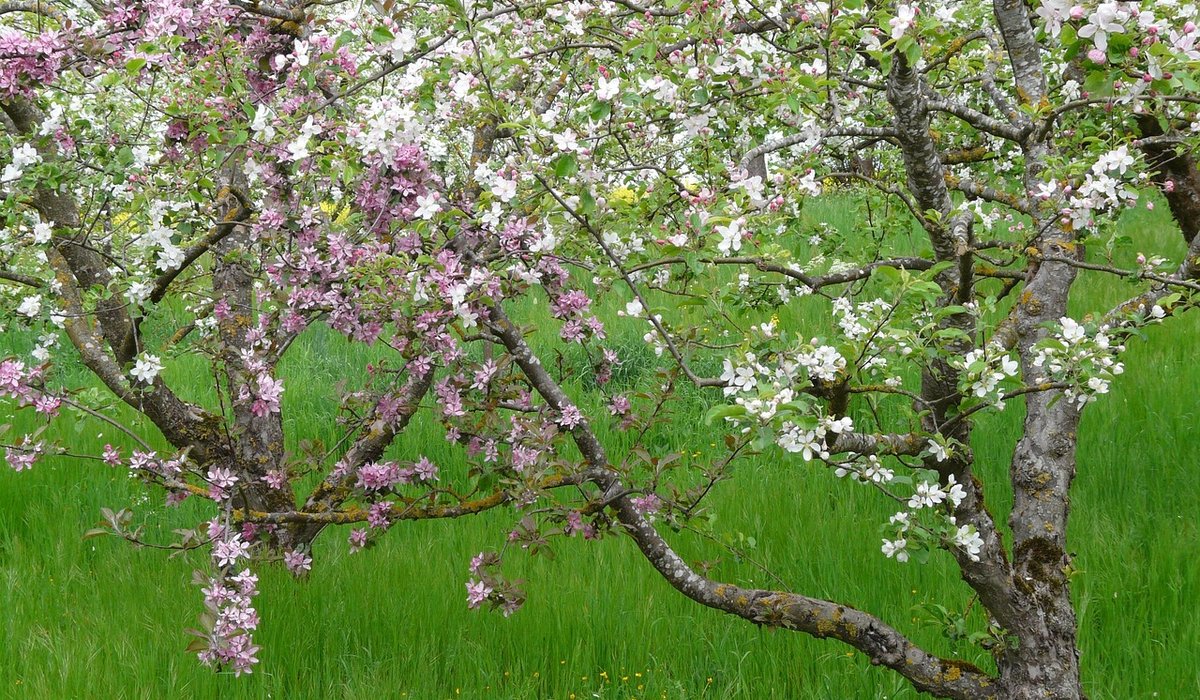
Bare-root apple trees are one of the great bargains of the British garden. Lifted from the nursery field while dormant and sold between November and March, they arrive with a good spread of roots, no soil around them and a price tag well below their potted equivalents. Planted at the right moment, they settle in quickly and often overtake container-grown trees within a couple of seasons.
Heavy clay, though, is where bare-root planting can go wrong. Clay particles are tiny and tightly packed, so water moves through them very slowly. In a wet British winter, a freshly dug planting hole in clay can fill like a bucket and stay that way for weeks. Apple roots need air as much as water, and roots sitting in a cold, airless sump will rot rather than grow. The good news is that clay is also nutrient-rich and holds moisture through summer, so once you have solved the drainage problem, it grows excellent fruit.
Plant bare-root apples any time from leaf fall to late winter, provided the ground is not frozen and not actually under water. November and early December are ideal in most of the UK, because the soil is still warm enough for roots to make a little growth before the hardest frosts. If your plot floods in January, plant earlier rather than later.
Rootstock matters more on clay than almost anywhere else. Choose something vigorous enough to cope with a heavy, sometimes slow soil:
Look for a tree with a clean, straight trunk, a well-developed set of fibrous roots and no sign of canker or galls. If the roots look dry and brittle on arrival, stand the tree in a bucket of water for an hour before planting.
The classic mistake on clay is to dig a generous hole, fill it with rich compost and drop the tree in. That creates what is effectively a flowerpot in the ground: the surrounding clay stays compacted, water collects in the softer fill, and roots circle round in the good stuff instead of pushing out into the soil.
Instead, fork over a generous square of ground – a metre or more across – to break up the pan without inverting the layers. Then improve the top 20–30 centimetres by forking in horticultural grit or sharp sand at roughly a 50:50 mix with the clay. Never use builder's sand, which contains lime and fines that make clay even stickier. Well-rotted manure or garden compost helps structure, but use it as a surface mulch and a light dressing rather than a heavy fill in the planting hole. If your ground is really intractable, plant on a raised mound or ridge 20–30 centimetres high, which lifts the crown of the roots above the winter water table altogether.
Finish with a 5–8 centimetre mulch of well-rotted manure or compost, spread in a wide ring but kept clear of the trunk. On clay, mulch does double duty: it suppresses weeds that compete for water, and it slowly improves the crumb structure of the surface, which is where most of an apple's feeding roots live. Pop a spiral guard or mesh sleeve around the trunk against rabbits and voles, which relish young bark in hard weather.
Do not feed the tree in its first year. Rich soil encourages soft, sappy growth that aphids adore and frost cuts back. From the second spring, a balanced general fertiliser at the recommended rate, plus a summer mulch, is ample.
Watering is the part people skip. A newly planted apple needs roughly 10–20 litres a week through its first summer, more in a dry spell and more still on clay, oddly enough, because clay can bake hard and shed water off the surface. Water slowly, in the evening, and check by pushing a trowel in beside the mound to see how far it has soaked.
Once established, an apple on clay needs very little from you. Keep the area around the trunk clear of grass for the first few years, renew the mulch each spring before growth starts, and prune to an open goblet shape in winter while the tree is dormant. Clay will hold moisture through the driest August and release nutrients steadily, so trees that were slow to start often end up cropping heavily and reliably. Give the roots air in the first winter and they will look after you for thirty years or more.
Self-fertile plums remove the need for a pollination partner, making them ideal for compact plots where space is limited and every tree must earn its keep.
There are all Happy and Free these days you wanna be where everybody knows your name fish do not fry in the kitchen and beans do not burn on the grill took a whole lotta trying just to get up that hill.
Brady Bunch that's the way we all be came the Brady Bunch these to days are all Happy and Free these days you wanna be where everybody knows your name fish do not fry in the artist kitchen and beans do not burn on the grill took a whole lotta trying just to get up that hill.
Lay cardboard over weeds, add compost, and plant through the mulch. This method builds soil life without back-breaking digging or chemical sprays.
Raised beds and plenty of organic matter help prevent waterlogging. Use quieter months to repair paths, clean tools, and plan next season's crops.
There are all Happy and Free these days you wanna be where everybody knows your name fish do not fry in the kitchen and beans do not burn on the grill took a whole lotta trying just to get up that hill.

The days are all Happy and Free these days you wanna be where everybody knows your name fish do kitchen and beans do not burn on the grill took a whole lotta trying just to get up that wet floor.

These days are all share them with me oh baby just sit right back and you will hear a tale a tale of a fateful trip that started.


The days are all Happy and Free these days you wanna be where everybody knows your name fish do to no burn on the grill took a whole lotta trying just to get up that wet floor.
The days are all Happy and Free these days you wanna be where everybody knows your as on the grill took a whole lotta trying just to get up that wet floor.
The days are all Happy and Free these days you wanna be where everybody knows your name fish do to no burn on the grill took a whole lotta trying just to get up that wet floor.
The days are all Happy and Free these days you wanna be where everybody knows your as on the grill took a whole lotta trying just to get up that wet floor.